
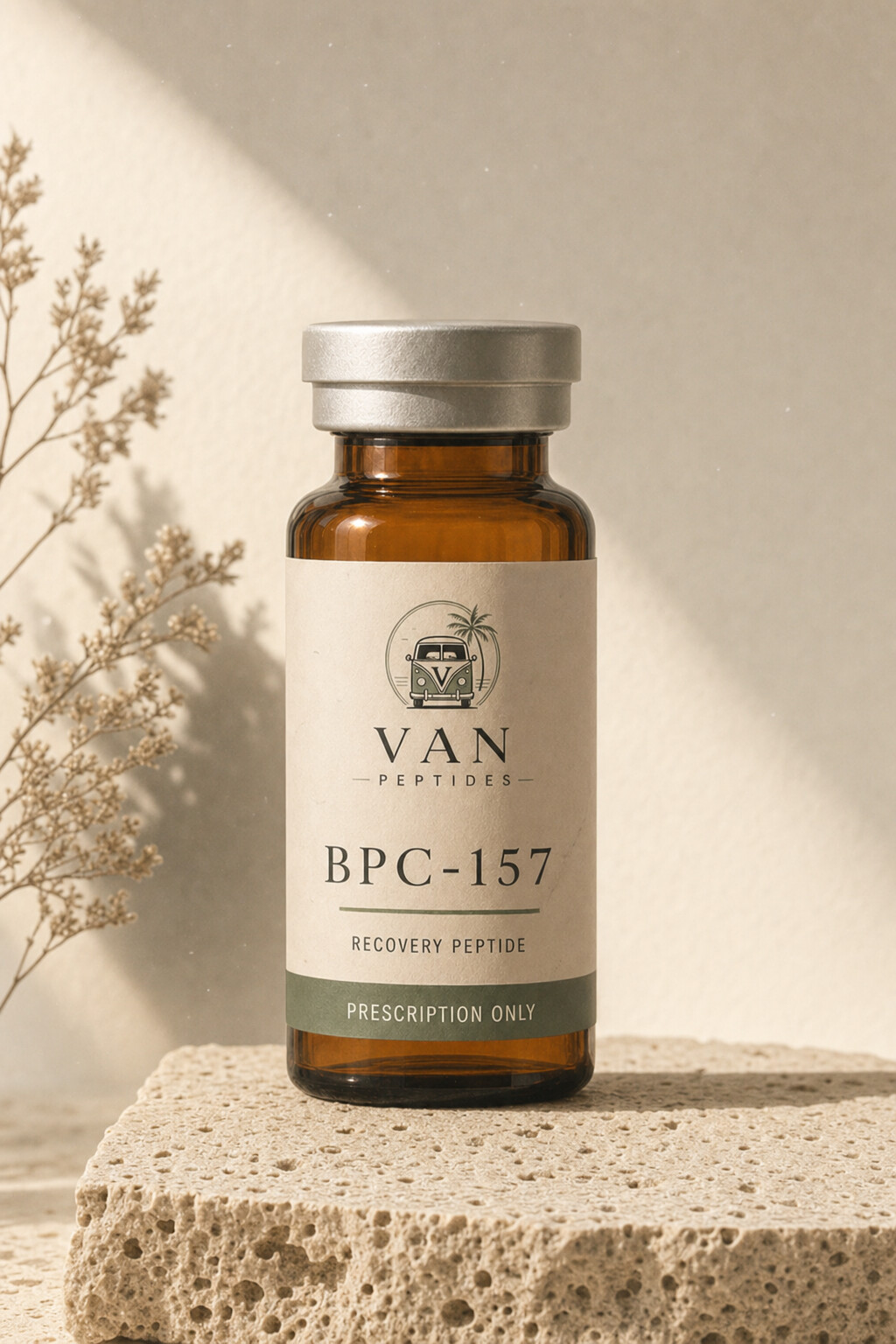
Performance & recovery · Prescription only
BPC-157
A body-protective peptide studied for its role in tendon and soft-tissue recovery, available after a licensed-provider evaluation.
Treatment length is confirmed at checkout after your provider approves treatment.
Beginning treatment does not create a prescription. A US-licensed provider reviews your intake first, and an order is only filled if they determine treatment is appropriate for you.
Treatment details
- Medication
- BPC-157
- Category
- Performance & recovery
- Access
- Available after a licensed-provider evaluation
- Fulfillment
- Compounded by a US-licensed compounding pharmacy
- FDA status
- Compounded — not FDA-approved
- Shipping
- Discreet, United States only
$189.00 is a placeholder price pending final confirmation. Van Peptides does not compound, manufacture, or dispense medication itself.
What it is
BPC-157 is a synthetic pentadecapeptide derived from a protective protein found in human gastric juice. Researchers have classified it within a family of body-protective peptides studied largely in animal models of tendon, ligament, and soft-tissue injury, where it has been associated with angiogenesis and fibroblast activity through pathways such as VEGFR2 and Akt-eNOS signaling (Current Reviews in Musculoskeletal Medicine, 2025). Outcomes are individual, and most of the mechanistic story so far comes from preclinical work rather than large human trials.
Van Peptides does not sell BPC-157 over the counter. It is available after a licensed-provider evaluation, and any prescription that follows is compounded through a US-licensed compounding pharmacy rather than manufactured by Van Peptides itself.
Van Peptides connects patients with an independent network of US-licensed providers. We do not diagnose, prescribe, or dispense anything ourselves; that judgment sits with a licensed provider who reviews your history first.
What the literature has explored
The bulk of published BPC-157 work is preclinical: rodent tendon-transection and ligament-injury models describe faster reepithelialization, increased collagen organization, and improved vascularization in the treated tissue compared to controls (Current Reviews in Musculoskeletal Medicine, 2025). Proposed mechanisms include upregulation of vascular endothelial growth factor receptor-2 (VEGFR2) and nitric oxide signaling through the Akt-eNOS axis, both of which are relevant to how new blood vessels form in poorly vascularized tissue like tendon.
Human data remains limited and is largely observational or anecdotal rather than randomized and controlled. That gap matters: a mechanism that looks promising in a rat tendon model does not automatically translate to a predictable effect in a person. Individual results vary, and a US-licensed provider is the right person to weigh whether the existing evidence supports use in your specific situation.
We are not making an outcome guarantee here, and no reputable source should. What we can say is that BPC-157 is one of the more frequently studied body-protective peptides in the soft-tissue repair literature, which is why it comes up often in conversations between patients and their providers about recovery-focused options.
How the telehealth path works
- Complete a short online intake.
- A US-licensed provider reviews your history and speaks with you if appropriate.
- If clinically appropriate, a prescription is issued and routed to a US-licensed compounding pharmacy.
- The medication ships discreetly in the US, with dispensing instructions from the pharmacy.
Van Peptides is a technology platform. It does not diagnose, prescribe, compound, or dispense. Each step above is carried out by an independent US-licensed provider or a US-licensed compounding pharmacy.
Common questions
What is BPC-157?
It is a synthetic peptide studied mainly in preclinical models of tendon and soft-tissue repair, with proposed mechanisms involving blood vessel formation and fibroblast activity.
Who is a candidate?
That determination is made by a US-licensed provider after reviewing your intake and history; it is available after a licensed-provider evaluation, not a self-selected purchase.
Is it FDA approved?
No. Compounded BPC-157 is not FDA approved. No FDA-approved brand-name version of BPC-157 exists.
How is it dispensed?
If a provider issues a prescription, it is compounded through a US-licensed compounding pharmacy and shipped directly to you.
What does it cost?
Placeholder plan pricing is $149 monthly, $399 for a three-month plan, and $749 for a six-month plan. Final pricing will be confirmed before this page goes live.
How is my privacy protected?
Intake information is handled under our HIPAA Notice of Privacy Practices; see our HIPAA notice for details.
What if it isn’t right for me?
A licensed provider may determine that BPC-157 is not appropriate for you, in which case they will discuss alternative options or next steps as part of your evaluation.
Related medications
Wolverine
Performance & recovery · $259.00 · available after a licensed-provider evaluation
CJC-1295 / Ipamorelin
Performance & recovery · $219.00 · available after a licensed-provider evaluation
Tesamorelin
Performance & recovery · $329.00 · available after a licensed-provider evaluation
Sermorelin (High Dose)
Performance & recovery · $219.00 · available after a licensed-provider evaluation