
Performance & recovery · Prescription only
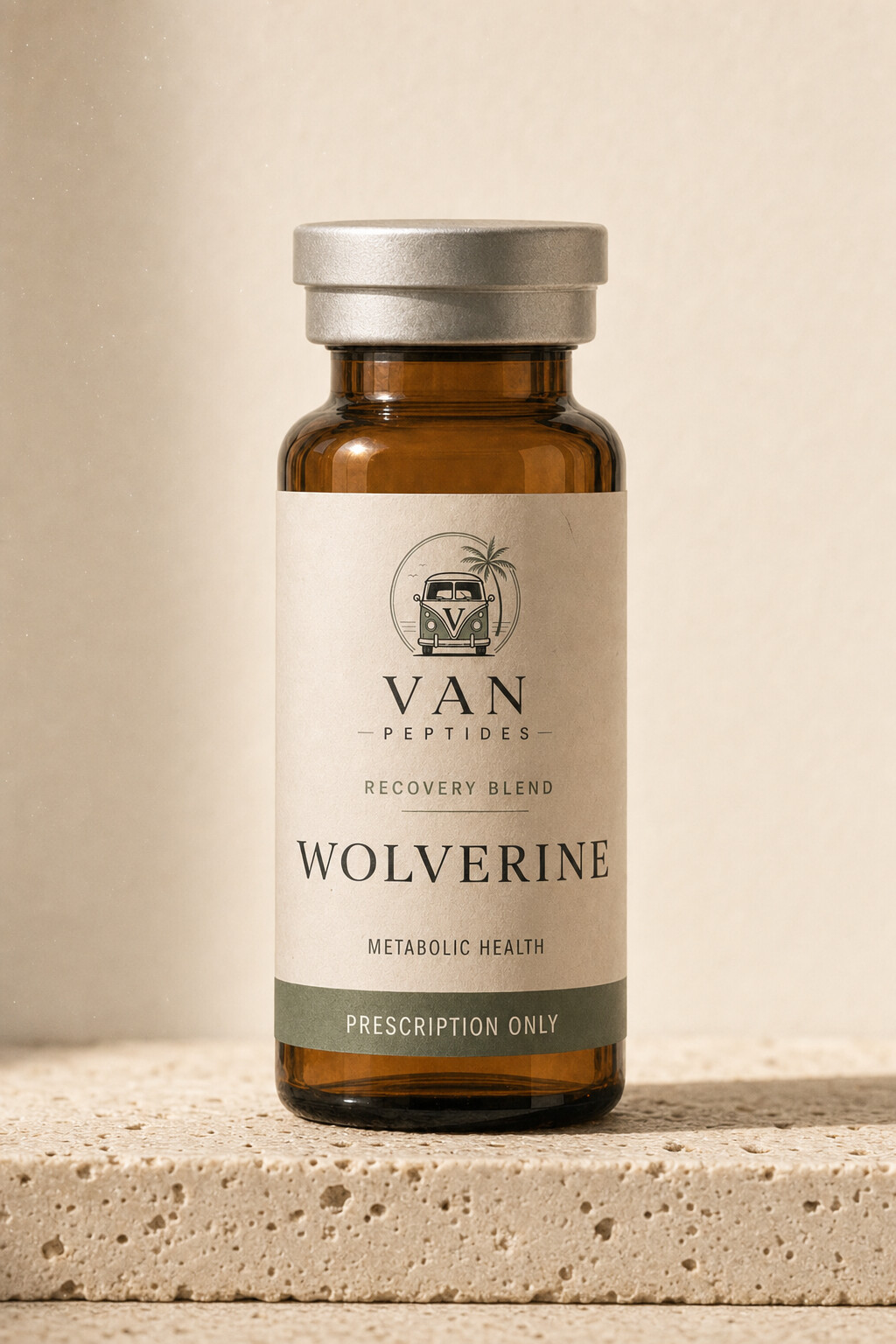
Wolverine
BPC-157 + TB-500, a recovery-focused pairing available after a licensed-provider evaluation.
Treatment length is confirmed at checkout after your provider approves treatment.
Beginning treatment does not create a prescription. A US-licensed provider reviews your intake first, and an order is only filled if they determine treatment is appropriate for you.
Treatment details
- Medication
- Wolverine
- Category
- Performance & recovery
- Access
- Available after a licensed-provider evaluation
- Fulfillment
- Compounded by a US-licensed compounding pharmacy
- FDA status
- Compounded — not FDA-approved
- Shipping
- Discreet, United States only
$259.00 is a placeholder price pending final confirmation. Van Peptides does not compound, manufacture, or dispense medication itself.
What it is
Wolverine is Van Peptides’ name for a compounded combination of BPC-157 and TB-500, two peptides frequently studied together in the soft-tissue recovery literature. BPC-157 is a synthetic pentadecapeptide associated in preclinical models with angiogenesis and fibroblast activity via VEGFR2 and Akt-eNOS signaling (Current Reviews in Musculoskeletal Medicine, 2025). TB-500 is a synthetic peptide derived from the actin-binding region of thymosin beta-4, a naturally occurring protein studied for its role in cell migration and wound repair (Sosne et al., J Invest Dermatol, 1999, PMID 10469335; Goldstein et al., Expert Opin Biol Ther, 2012, PMID 22074294). Outcomes are individual, and no published study has tested BPC-157 and TB-500 together as a single combined protocol.
The name reflects the recovery theme of the literature behind these two peptides, not a claim about outcomes. Wolverine is available after a licensed-provider evaluation, and it is compounded through a US-licensed compounding pharmacy rather than produced by Van Peptides.
Van Peptides connects patients with an independent network of US-licensed providers for this evaluation. We do not diagnose, prescribe, or dispense, and we do not employ the providers or the pharmacy that fulfills a prescription.
What the literature has explored
Thymosin beta-4, the parent molecule of TB-500, has been studied in animal wound models where it accelerated reepithelialization and increased collagen deposition and angiogenesis in full-thickness skin wounds (Sosne et al., 1999, PMID 10469335). A broader review of thymosin beta-4 biology describes activity across cell migration, blood vessel formation, and reduced scar-forming myofibroblast activity, largely from animal and in vitro work, with early-phase human trials in specific indications like corneal and dermal repair (Goldstein et al., 2012, PMID 22074294).
A 2026 scoping review of the TB-500 literature specifically noted that the evidence base remains weighted toward in vitro and animal designs, with direct human evidence for the synthetic 17-amino-acid fragment (as opposed to full thymosin beta-4) still limited. BPC-157’s supporting literature carries a similar profile: promising mechanistic and preclinical tendon-repair findings, with human data still developing. Outcomes are individual, and pairing two peptides does not mean their preclinical findings simply add together in a person.
None of this is a promise about what you, specifically, might experience. It is a summary of where the published science currently stands, and a US-licensed provider is who should translate that into a decision about your care.
How the telehealth path works
- Complete a short online intake.
- A US-licensed provider reviews your history and speaks with you if appropriate.
- If clinically appropriate, a prescription is issued and routed to a US-licensed compounding pharmacy.
- The medication ships discreetly in the US, with dispensing instructions from the pharmacy.
Van Peptides is a technology platform. It does not diagnose, prescribe, compound, or dispense. Each step above is carried out by an independent US-licensed provider or a US-licensed compounding pharmacy.
Common questions
What is Wolverine?
It is Van Peptides’ name for a compounded combination of BPC-157 and TB-500, two peptides studied, often separately, in the soft-tissue and wound-repair literature.
Who is a candidate?
A US-licensed provider determines candidacy after reviewing your intake and history; it is available after a licensed-provider evaluation.
Is it FDA approved?
No. Neither BPC-157 nor TB-500, alone or combined, is FDA approved, and no FDA-approved brand-name version of either exists.
How is it dispensed?
If prescribed, the combination is compounded through a US-licensed compounding pharmacy and shipped to you.
What does it cost?
Placeholder plan pricing is $149 monthly, $399 for a three-month plan, and $749 for a six-month plan. Final pricing will be confirmed before this page goes live.
How is my privacy protected?
Intake information is handled under our HIPAA Notice of Privacy Practices.
What if it isn’t right for me?
If a provider determines this stack is not appropriate for you, they will discuss alternatives, including the individual components, as part of your evaluation.